Korea Value-Up Filing Audit: Separating True Share Cancellations on KOSDAQ (JVM, BGF Eco Materials) From Wage-Linked Treasury Disposals on KOSPI (Kia, Hyundai Mobis)
On October 30, 2026, four DART filings on the same afternoon exposed the single most important governance distinction in Korea's Value-Up program: permanent share cancellation under Commercial Act Article 343(1) versus treasury share disposal back into the public float.
As of 2026.10.31 (Source: Korean FSS DART Share Cancellation (주식소각결정) and Treasury Share Disposal (자기주식처분결정) Filings filed 2026.10.30) · Growth rates, ratios, and baselines not printed directly in the primary releases were calculated by me from the disclosed financial statements and are marked (Calc.) in the tables.
For foreign investors evaluating South Korea's Corporate Value-Up reforms, reading the headline of a "Treasury Stock (자기주식)" announcement without checking the exact DART form type is a recurring trap. In the United States, repurchased shares are almost always retired or netted against diluted share count. In South Korea, however, treasury shares sit on the balance sheet as a dormant pool that management can later re-issue into the market (자기주식처분결정)—expanding the active free float and diluting per-share claims—unless the Board passes a formal Share Cancellation Resolution (주식소각결정) under Article 343(1) of the Korean Commercial Act.
On Friday, October 30, 2026, two KOSDAQ mid-caps and two KOSPI automotive bellwethers filed treasury-stock disclosures within hours of one another. Putting those eight related DART filings side by side shows why governance-focused capital must audit KOSDAQ and KOSPI filings line by line rather than relying on index membership [1][4][6][8].
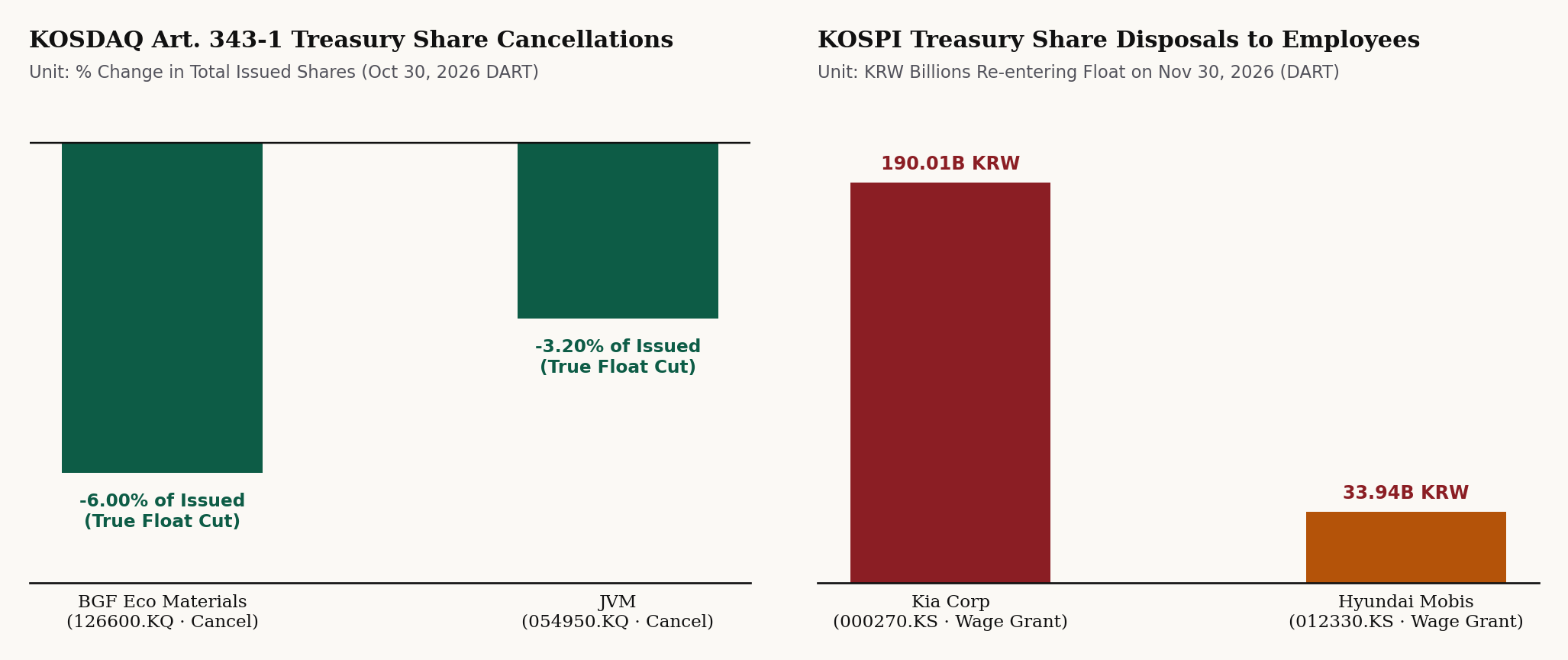
Left: October 30, 2026 KOSDAQ permanent share cancellations as a percentage of total issued shares (BGF Eco Materials 126600.KQ -6.00%, JVM 054950.KQ -3.20%). Right: October 30, 2026 KOSPI treasury share disposals re-entering circulation on November 30, 2026 to settle employee wage agreements (Kia 000270.KS 190.01B KRW, Hyundai Mobis 012330.KS 33.94B KRW) [1][4][6][8].
| Issuer & Filing Type (2026.10.30) | Share Count, KRW Value & Float Impact |
|---|---|
| JVM (054950.KQ, KOSDAQ) Share Cancellation ( 주식소각결정) |
Permanently canceling 387,032 common shares out of 12,089,892 issued shares (-3.20% of issued shares, Calc.); book value 15,902,384,907 KRW (15.90B KRW); cancellation date 2026.11.06; filed alongside 3Q26 OP +30.4% YoY (24.43% OPM Calc.) [1][2][3] |
| BGF Eco Materials (126600.KQ, KOSDAQ) Share Cancellation ( 주식소각결정) |
Permanently canceling 3,764,752 common shares out of 62,766,899 issued shares (-6.00% of issued shares, Calc.); cost 14,494,295,200 KRW (14.49B KRW, 3,850 KRW/sh Calc.) acquired via Oct 8–27 tender offer; cancellation date 2026.11.10 [4][5] |
| Kia Corporation (000270.KS, KOSPI) Treasury Disposal ( 자기주식처분결정) |
Re-issuing 1,754,496 treasury shares at 108,300 KRW/sh = 190,011,916,800 KRW (190.01B KRW) on 2026.11.30 to 30,916 employees under the 2026 wage agreement (disposing of 99.86% Calc. of its 1,756,955 held treasury shares) [6][7] |
| Hyundai Mobis (012330.KS, KOSPI) Treasury Disposal ( 자기주식처분결정) |
Re-issuing 96,136 treasury shares at 353,000 KRW/sh = 33,936,008,000 KRW (33.94B KRW) on 2026.11.30 to company employees under the 2026 collective bargaining agreement (6.19% Calc. of its 1,552,000 held treasury shares) [8] |
1. Genuine Per-Share Accretion on KOSDAQ: JVM (054950.KQ) & BGF Eco Materials (126600.KQ)
Under the proviso to Article 343(1) of the Korean Commercial Act, a company can cancel treasury shares held within distributable profit via a simple Board resolution—reducing the total issued share count without reducing paid-in capital. Two KOSDAQ industrial leaders executed textbook cancellations on October 30:
- JVM (
054950.KQ, Subsidiary of KOSPI-listed Hanmi Science008930.KS): JVM is South Korea's dominant hospital and pharmacy medication-packaging automation exporter. On October 30, JVM filed two simultaneous disclosures: (1) 3Q26 preliminary consolidated earnings showing revenue of 40,545 million KRW (+2.1% YoY, -17.8% QoQ), operating profit of 9,907 million KRW (+30.4% YoY, 24.43% OPM Calc. vs. 19.13% in 3Q25; 9M26 OP 32,722M KRW, +19.6% YoY, 24.18% OPM Calc.), and net income of 9,590 million KRW (+49.9% YoY) [3]; and (2) an unanimous Board resolution (4 of 4 independent directors present) to permanently cancel 387,032 existing treasury shares (3.20% of its 12,089,892 total issued shares, Calc.) carrying a book value of 15,902,384,907 KRW (15.90B KRW) on November 6, 2026 [1][2]. - BGF Eco Materials (
126600.KQ, Subsidiary of KOSPI-listed BGF027410.KS): Even more aggressive in percentage terms, specialty semiconductor gas and engineering-plastics producer BGF Eco Materials resolved on October 30 to permanently cancel 3,764,752 common shares—exactly 6.00% of its 62,766,899 total issued shares (Calc.)—valued at 14,494,295,200 KRW (14.49B KRW) on November 10, 2026 [4][5]. Crucially, the footnote in Item 11 confirms that these 3,764,752 shares were acquired through a public tender offer run from October 8 to October 27, 2026 (settled October 29) for the explicit purpose of immediate retirement [4].
2. The Other Side of Korean Treasury Stock: 223.95B KRW of Wage Disposals at Kia & Hyundai Mobis
Contrast those KOSDAQ cancellations with two Major Event Reports (주요사항보고서: 자기주식처분결정) filed on the same day by KOSPI heavyweights Kia Corporation (000270.KS) and Hyundai Mobis (012330.KS) [6][8]:
- Kia Corporation (
000270.KS): Prior to October 30, Kia held 1,756,955 common shares in treasury (0.45% of shares). In its October 30 filing, Kia's Board approved the disposal of 1,754,496 treasury shares (99.86% of its held treasury stock, Calc.) at the October 29 closing price of 108,300 KRW per share—totaling 190,011,916,800 KRW (190.01B KRW)—to be transferred directly from the company's treasury account to the personal brokerage accounts of 30,916 employees on November 30, 2026 pursuant to the 2026 collective wage agreement [6]. This was filed alongside Kia's 3Q26 preliminary earnings (`31.60T KRW` revenue, `+10.1% YoY`; `1.82T KRW` operating profit, `-30.8% QoQ`, `+24.3% YoY`, `5.75% OPM Calc.`) [7]. - Hyundai Mobis (
012330.KS): In an identical structure, Hyundai Mobis resolved on October 30 to dispose of 96,136 treasury shares at 353,000 KRW per share—totaling 33,936,008,000 KRW (33.94B KRW)—on November 30, 2026 to pay employee performance grants agreed in its 2026 collective bargaining settlement [8].
3. Analytical Takeaway & Checklist for Foreign Investors
When a Korean issuer buys back stock without canceling it, and later distributes 223.95 billion KRW (Calc.) of those treasury shares to employees as wage compensation, the cash outlay at the time of the original buyback was effectively a pre-funded labor expense—not a permanent reduction in share count. Recall from our earlier SK Hynix 3Q26 audit that SK Hynix explicitly excluded the 10 trillion KRW employee-compensation portion of its 20 trillion KRW buyback from its shareholder-return calculation for this exact reason. Foreign investors screening Korea's Value-Up universe should treat DART Form 주식소각결정 (Cancellation)—such as JVM's 3.20% and BGF Eco Materials' 6.00% float reductions on KOSDAQ—as the only verified denominator reduction [1][4].
Sources
- DART JVM (054950.KQ) Share Cancellation Decision (387,032 Shares), 2026.10.30.
- DART Hanmi Science (008930.KS) Subsidiary Material Management Report (JVM Share Cancellation), 2026.10.30.
- DART JVM (054950.KQ) Preliminary Consolidated 3Q26 Earnings Fair Disclosure, 2026.10.30.
- DART BGF Eco Materials (126600.KQ) Share Cancellation Decision (3,764,752 Shares), 2026.10.30.
- DART BGF (027410.KS) Subsidiary Material Management Report (BGF Eco Materials Share Cancellation), 2026.10.30.
- DART Kia Corporation (000270.KS) Major Event Report: Treasury Share Disposal Decision (190.01B KRW), 2026.10.30.
- DART Kia Corporation (000270.KS) Preliminary Consolidated 3Q26 Earnings Fair Disclosure, 2026.10.30.
- DART Hyundai Mobis (012330.KS) Major Event Report: Treasury Share Disposal Decision (33.94B KRW), 2026.10.30.